
What part of the brain controls hearing?
Your auditory cortex, in the temporal lobe at the side of your head, is the main part of your brain that processes what you hear. Signals for sound travel from your inner ear along the vestibulocochlear nerve to your brainstem. From there they pass through the inferior colliculus of your midbrain and the medial geniculate nucleus of your thalamus to the cortex.
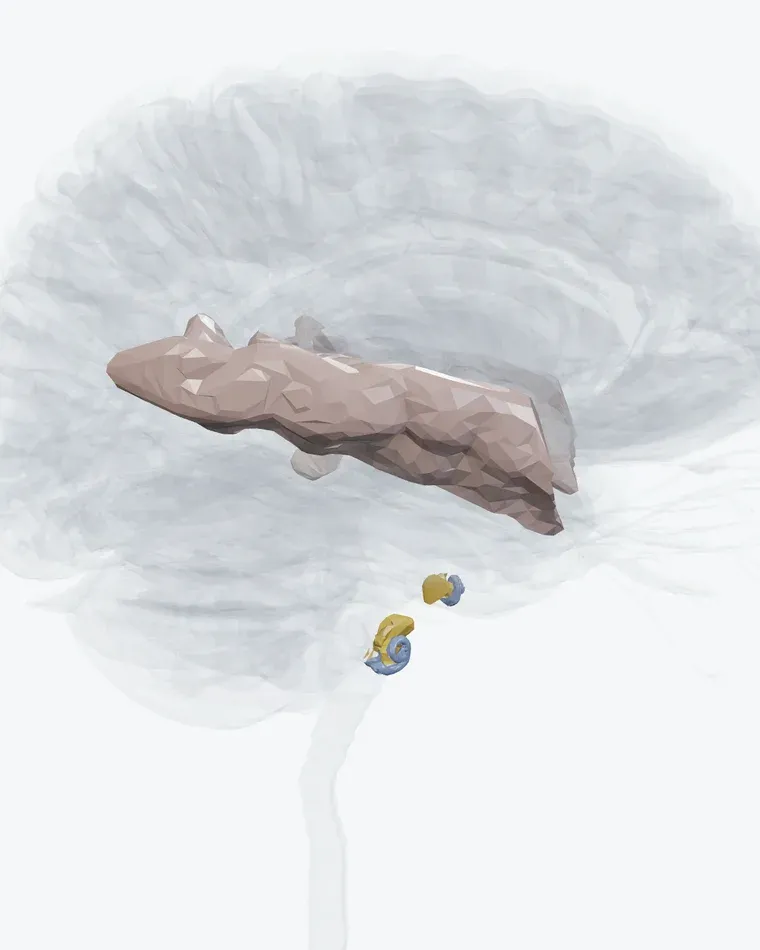
The parts involved
Choose a part to light it up.
- Auditory cortexReceives and processes the signals for hearing. Its primary area, at the top of the temporal lobe, is where sounds first reach the cortex. More about the auditory cortex
- Geniculate nucleiReceive the signals for hearing in the medial geniculate nucleus, at the back of your thalamus, and pass them on to the auditory cortex. More about the geniculate nuclei
- Superior and inferior colliculiPass the signals for hearing up to your thalamus (the inferior pair) and set off the muscles that turn your head and neck towards a sound (the superior pair). More about the superior and inferior colliculi
- Vestibulocochlear nerveCarries the signals for hearing, in its cochlear part, from your cochlea to your brainstem. More about the vestibulocochlear nerve
- Inner earTurns sound into nerve signals in the cochlea, a fluid-filled, snail-shaped structure that holds the hair cells for hearing. More about the inner ear
Where is hearing in the brain?
Hearing is handled in your temporal lobe, the part of each half of your brain at the side of your head. Each temporal lobe has its own auditory cortex, so you have one on the left and one on the right.
Sounds reach the cortex first in the primary auditory cortex, in the upper part of the temporal lobe. That is where they start to be consciously heard. Gray's Anatomy (1918) puts the area for hearing on the superior temporal gyrus, the top ridge of the temporal lobe, and on the transverse temporal gyri. These are three or four ridges, also called Heschl's gyri, hidden inside the lateral sulcus, the deep groove above the lobe.
The work then carries on in the areas next to the primary auditory cortex, the auditory association cortex. There is some evidence that hearing, like seeing, works in two parallel streams. One recognises what a sound is, and the other finds where it comes from.
How does sound get from your ear to your brain?
Signals for sound take this path:
- Sound sets the fluid inside the cochlea of your inner ear moving. Hair cells, the ear's sensing cells, turn the movement into nerve signals.
- The signals travel along the cochlear nerve, the hearing part of your vestibulocochlear nerve.
- They reach the cochlear nuclei, in the upper part of your medulla oblongata, the lowest part of your brainstem. In the brainstem, the signals from your two ears are combined.
- Next the signals pass up to the inferior colliculus, one of four small bumps on the back of your midbrain.
- From there they go to the medial geniculate nucleus of your thalamus, the brain's relay station for every sense but smell.
- The medial geniculate nucleus sends them on to the auditory cortex. Many of its fibres sweep back and outward as the acoustic radiation, and they end in the superior temporal gyrus.
Why do you turn towards a sound?
Your superior colliculus, one of the upper pair of bumps on the back of your midbrain, sets off the muscles that turn your head and neck towards a sound. It gets the signals from your ears through the inferior colliculus. The superior colliculus also brings together where things are in what you see, hear and feel. When a bird chirps in a tree above you, your superior colliculi match the sound with where you see the tree.
Your brainstem works out where a sound comes from by comparing what reaches your two ears. A sound from your left reaches your left ear a tiny fraction of a second before your right ear. It is also slightly louder in your left ear, because your head blocks some of the sound on its way to the right one.
Where do you understand words?
Wernicke's area is important for understanding speech. It lies beside the auditory association cortex, at the end of the lateral sulcus. After damage to Wernicke's area, a person can still speak but can't understand what others say. In most people, language is based on the left side of the brain. Broca's area, in the frontal lobe, and Wernicke's area are two areas of the cortex that work on speech and language.
Every fact on this page is checked against the sources below. Last checked:
Sources
- Gray's Anatomy of the Human Body, 20th edition (1918)
- Anatomy and Physiology (OpenStax, 2013)
- Psychology (OpenStax, 2014)
- SEER Training Modules (National Cancer Institute)
- NCI Thesaurus (National Cancer Institute)
- Terminologia Anatomica, 2nd edition (FIPAT, 2019)
- cochlea (TA2 6964)
- superior temporal gyrus (TA2 5489)
- transverse temporal gyri (TA2 5491)
- cochlear nerve (TA2 6318)
- acoustic radiation (TA2 5587)
- Foundational Model of Anatomy (University of Washington)