
What part of the brain controls speech and language?
Broca's area, in the frontal lobe at the front of your brain, controls the movements you make to speak. Wernicke's area, in the temporal lobe beside the area for hearing, is important for understanding speech. In most people both areas are on the left side of the brain.
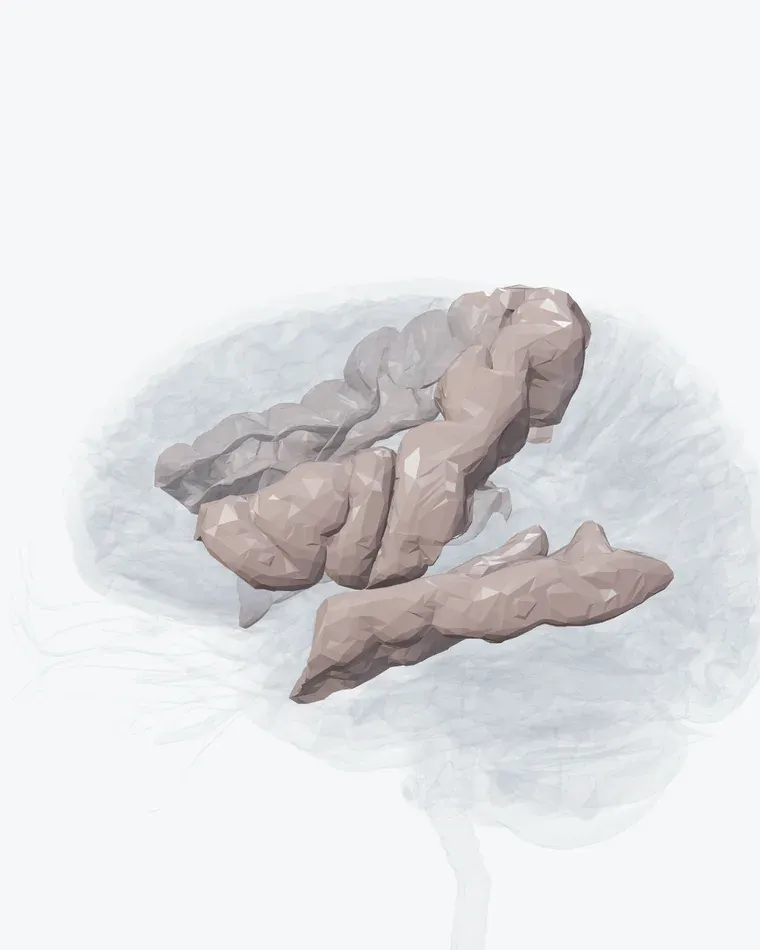
The parts involved
Choose a part to light it up.
- Broca's and Wernicke's areasPlan and control the movements of speech (Broca's area) and help you understand what is said to you (Wernicke's area). More about Broca's and Wernicke's areas
- Motor cortexSends out the commands that move your muscles, including those of your face. Broca's area lies just in front of the part that works your head and neck. More about the motor cortex
- Auditory cortexProcesses what you hear. Wernicke's area lies beside its auditory association cortex, in the temporal lobe. More about the auditory cortex
What does Broca's area do?
Broca's area controls the movements of the parts you speak with. It lies on the outer side of your frontal lobe, in the inferior frontal gyrus, the lowest of three parallel ridges on the side of the lobe. Psychology (OpenStax, 2014) calls Broca's area essential for producing language.
Broca's area is one of the areas in front of the motor cortex that help plan certain kinds of movement. It lies just in front of the part of the motor cortex that works your head and neck.
The motor cortex takes in signals from several areas that help plan movements. It sends out the commands that move your muscles. Its outer side, low down, holds the nerve cells for the muscles of your face. Muscles that make fine movements, such as those of your fingers and lower face, get the most space in the motor cortex. The motor cortex's commands go down to nerve cells in your brainstem and spinal cord, which make the muscles contract.
What does Wernicke's area do?
Wernicke's area is important for understanding speech. It lies in your temporal lobe, on the side of your head, where the lateral sulcus ends. The lateral sulcus is the deep groove above the temporal lobe. People with damage to Wernicke's area can still speak, but they can't understand language.
The auditory cortex, the main area that processes what you hear, is in the temporal lobe too. The signals for hearing reach it from your ears through your brainstem and thalamus. They arrive first in the primary auditory cortex, and the work carries on in the areas next to it, the auditory association cortex. Wernicke's area lies beside the auditory association cortex.
Wernicke's area and Broca's area are joined by tracts of white matter, bundles of nerve fibres that run between the back of the temporal lobe and the outer side of the frontal lobe. These tracts connect understanding language with producing speech.
Which side of the brain controls language?
In most people, language is based in the left hemisphere, the left half of your cerebrum. It is handled there between the upper part of the temporal lobe and the back of the frontal lobe. OpenStax's Anatomy and Physiology puts the language functions of the cortex on the left in 95 per cent of people. Psychology (OpenStax, 2014) reports evidence that the two halves of the brain differ, mainly in language ability. Beyond that, it says, the differences found have been minor.
Language isn't confined to the left side, though. It is spread widely around the cerebrum, and well-documented cases show language lost after damage to the right side. Damage on the right can take away the understanding of jokes, irony and metaphors. It can also take the feeling out of speech, so that a person sounds flat, like a robot.
What is aphasia?
Damage to Broca's area or Wernicke's area is linked with aphasia, a loss of speech or language. The kind of aphasia depends on which area is damaged.
The aphasia linked with Broca's area is called expressive aphasia. Producing speech becomes hard. A person may manage some words, but their speech is broken or halting, and grammar can seem to be lost. Broca's area is named after a French surgeon and anatomist. He studied patients who could not produce speech but could still understand it.
Receptive aphasia is the kind linked with Wernicke's area. Speech still comes, but the person loses the understanding of what is said. People who recover from a sudden form of receptive aphasia say they couldn't understand what was said to them, or even what they were saying themselves. They often couldn't stop talking.
Damage to the tracts between the two areas is linked with conduction aphasia, which is very rare. Conduction aphasia is likely to show as an inability to repeat spoken words accurately.
Every fact on this page is checked against the sources below. Last checked:
Sources
- Gray's Anatomy of the Human Body, 20th edition (1918)
- Anatomy and Physiology (OpenStax, 2013)
- Psychology (OpenStax, 2014)
- SEER Training Modules (National Cancer Institute)
- Terminologia Anatomica, 2nd edition (FIPAT, 2019)
- inferior frontal gyrus (TA2 5447)
- lateral sulcus (TA2 5436)
- Foundational Model of Anatomy (University of Washington)