
What part of the brain controls touch and pain?
Your somatosensory cortex, a ridge at the front of each parietal lobe, processes touch, pain and temperature. Signals from your skin, muscles and joints travel up your spinal cord to your thalamus, which passes them on to this cortex, where you first become aware of the feeling. The cortex holds a map of your body, with the area for your hand beside the area for your wrist.
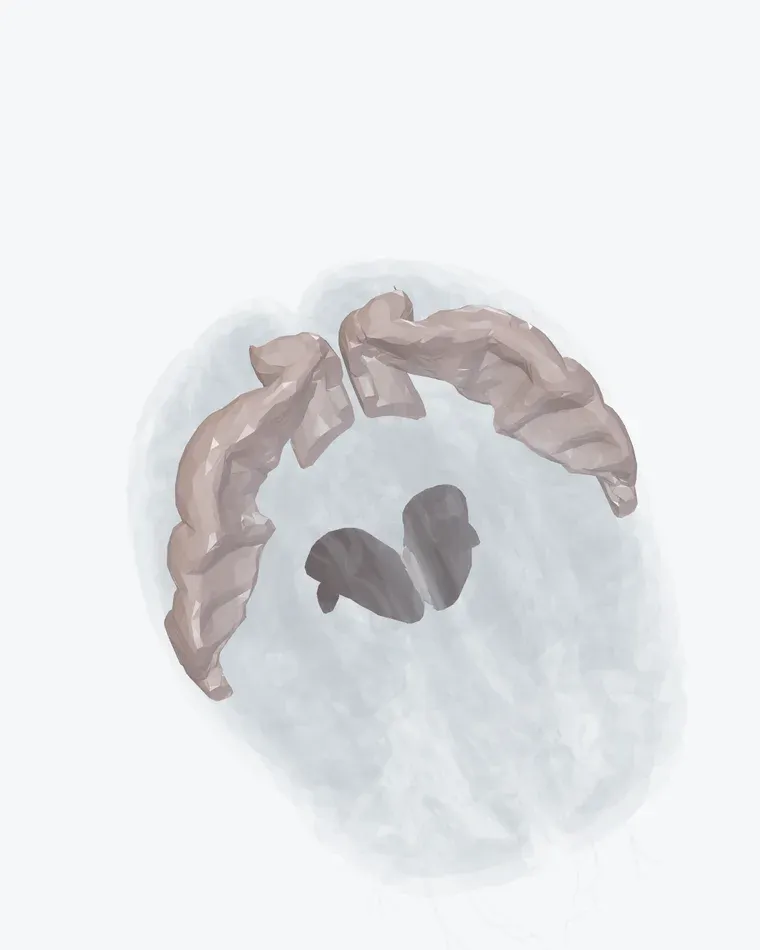
The parts involved
Choose a part to light it up.
- Somatosensory cortexReceives touch, pain and temperature from the opposite side of your body, and is where you first become aware of them. More about the somatosensory cortex
- ThalamusTakes in the signals for touch and pain that come up your spinal cord, processes them and passes them on to the somatosensory cortex. More about the thalamus
Where do you feel touch in your brain?
Touch is processed in your parietal lobe, the part of each half of your brain just behind the frontal lobe. The parietal lobe's front ridge, the postcentral gyrus, is the primary somatosensory cortex. It lies just behind the central sulcus, the groove between the parietal and frontal lobes. Just in front of the groove is the motor cortex, which sends out your commands for movement.
Touch, pressure, tickle, pain, itch and vibration are all processed in the postcentral gyrus, and so are temperature and the senses of your body's position and movement. Your parietal lobe also lets you recognise an object, such as a coin, by touch alone.
How do touch and pain reach your brain?
Sensors in your skin, muscles, tendons and joints pick up touch and the position of your body, and nerve endings pick up pain and temperature. From below your neck, the signals travel up two main spinal cord tracts, pathways that carry feeling up to the brain. Each is a chain of three nerve cells. The dorsal column, at the back of the cord, mainly carries touch and the sense of your body's position, and the spinothalamic tract mainly carries pain and temperature.
In both tracts, the second nerve cell ends in the thalamus, a relay deep in your brain, and the third carries the signal on to the postcentral gyrus. As the thalamus passes the signals on, it processes them. Signals from your face take another path, along the trigeminal nerve to your brainstem, but they also pass through the thalamus to the somatosensory cortex.
If you touch something hot, a reflex in your spinal cord pulls your hand away before you are aware of the pain.
Why is your body mapped on your brain?
Along the postcentral gyrus, each part of your body has its own area, laid out in the same order as your body. This order lets your brain tell where on your body a touch is, from which sensors are sending signals. The nerve fibres keep the order on their way up. In the dorsal column, those from your lower body run nearer the middle, and those from your upper body run further out.
The map starts inside the cleft between the two halves of your brain, with your genitals, feet and lower legs. It then runs down the side of the brain through your thighs, trunk, arms and hands to your face. It is often drawn as the sensory homunculus, from the Latin for "little man". The map isn't to scale: sensitive parts such as your fingers and lower face get larger areas than your shoulders and back.
Why does each side of the brain feel the other side of the body?
Each side of your brain feels the other side of your body because the pathways for touch and pain cross over on their way up. In both, the second nerve cell is the one that crosses. For touch and the sense of position, it crosses in the medulla oblongata, the lowest part of your brainstem. For pain and temperature, it crosses in the spinal cord, at the level where the signal comes in.
Because the two pathways cross at different places, testing touch and pain separately can show which pathway is damaged. The commands for movement cross over too, so each side of your brain also controls movement on the other side of your body.
Every fact on this page is checked against the sources below. Last checked:
Sources
- Gray's Anatomy of the Human Body, 20th edition (1918)
- Anatomy and Physiology (OpenStax, 2013)
- Psychology (OpenStax, 2014)
- SEER Training Modules (National Cancer Institute)
- NCI Thesaurus (National Cancer Institute)
- Terminologia Anatomica, 2nd edition (FIPAT, 2019)
- postcentral gyrus (TA2 5469)
- thalamus (TA2 5678)
- parietal lobe (TA2 5467)
- central sulcus (TA2 5435)
- spinothalamic tracts (TA2 6102)
- Foundational Model of Anatomy (University of Washington)